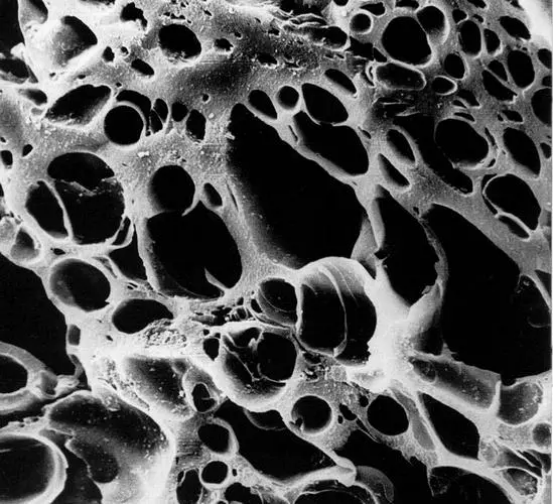
Adsorption principle of activated carbon
The adsorption capacity of activated carbon is related to its pore size and structure. Generally speaking, the smaller the particle size, the faster the pore diffusion rate, and the stronger the adsorption capacity of activated carbon.
The adsorption capacity of activated carbon is related to its pore size and structure. Generally speaking, the smaller the particle size, the faster the pore diffusion rate, and the stronger the adsorption capacity of activated carbon.
Adsorption capacity and adsorption rate are the main indicators for measuring the adsorption process. The size of adsorption capacity is measured by adsorption capacity, and adsorption rate refers to the amount adsorbed per unit weight of adsorbent per unit time. In water treatment, the adsorption rate determines the contact time between the adsorbent and the wastewater.
Adsorption is a slow process in which a substance adheres to the surface of another substance. Adsorption is an interface phenomenon that is related to changes in surface tension and surface energy. There are two types of driving forces that cause adsorption, one is the repulsive force of solvent water on hydrophobic substances, and the other is the affinity attraction of solids to solutes. The adsorption in wastewater treatment is mostly the result of the combined action of these two forces. The specific surface area and pore structure of activated carbon directly affect its adsorption capacity. When selecting activated carbon, it should be determined through experiments based on the water quality of the wastewater. It is advisable to choose carbon species with well-developed transition pores for printing and dyeing wastewater. In addition, ash content also has an impact, the smaller the ash content, the better the adsorption performance; The closer the size of adsorbate molecules is to the diameter of carbon pores, the easier they are to be adsorbed; The concentration of adsorbate also has an impact on the adsorption capacity of activated carbon. Within a certain concentration range, the adsorption capacity increases with the increase of adsorbate concentration. In addition, water temperature and pH value also have an impact. The adsorption capacity decreases with the increase of water temperature and increases with the decrease of pH value. Therefore, low water temperature and low pH value are beneficial for the adsorption of activated carbon.
The adsorption effect of activated carbon
Adsorption refers to the action of liquid or gas adhering and concentrating on the surface of a solid, which can occur in general activated carbon. Adsorption is different from absorption. Absorption refers to the entry of liquid or gas into the internal atomic structure of a solid, but activated carbon does not have this ability. Its adsorption effect is only a surface phenomenon, so it only occurs on its surface.
The formation of adsorption mainly comes from the London dispersion force, which is also another manifestation of van der Waals force. This force is commonly present between molecules that do not have a permanent dipole moment, and it is a natural attraction. As long as the molecules are close enough, this force will naturally occur. Any action that can use this force to attract substances is called physical adsorption. This force is temperature independent and therefore not affected by temperature.